



Build understanding, practise with purpose and prepare for demanding exam questions
Mathematics Advanced requires students to understand concepts, carry out methods accurately and decide how to approach problems they have not seen before. A familiar technique can appear in an unfamiliar setting, especially in the more challenging questions of a trial or HSC paper.
Our lessons connect to each student’s school topics and the applicable NESA syllabus. We build understanding through clear teaching and regular practice, then use challenging exam-style problems to help students experience the decisions they will need to make in assessments.
Aligned with school learning
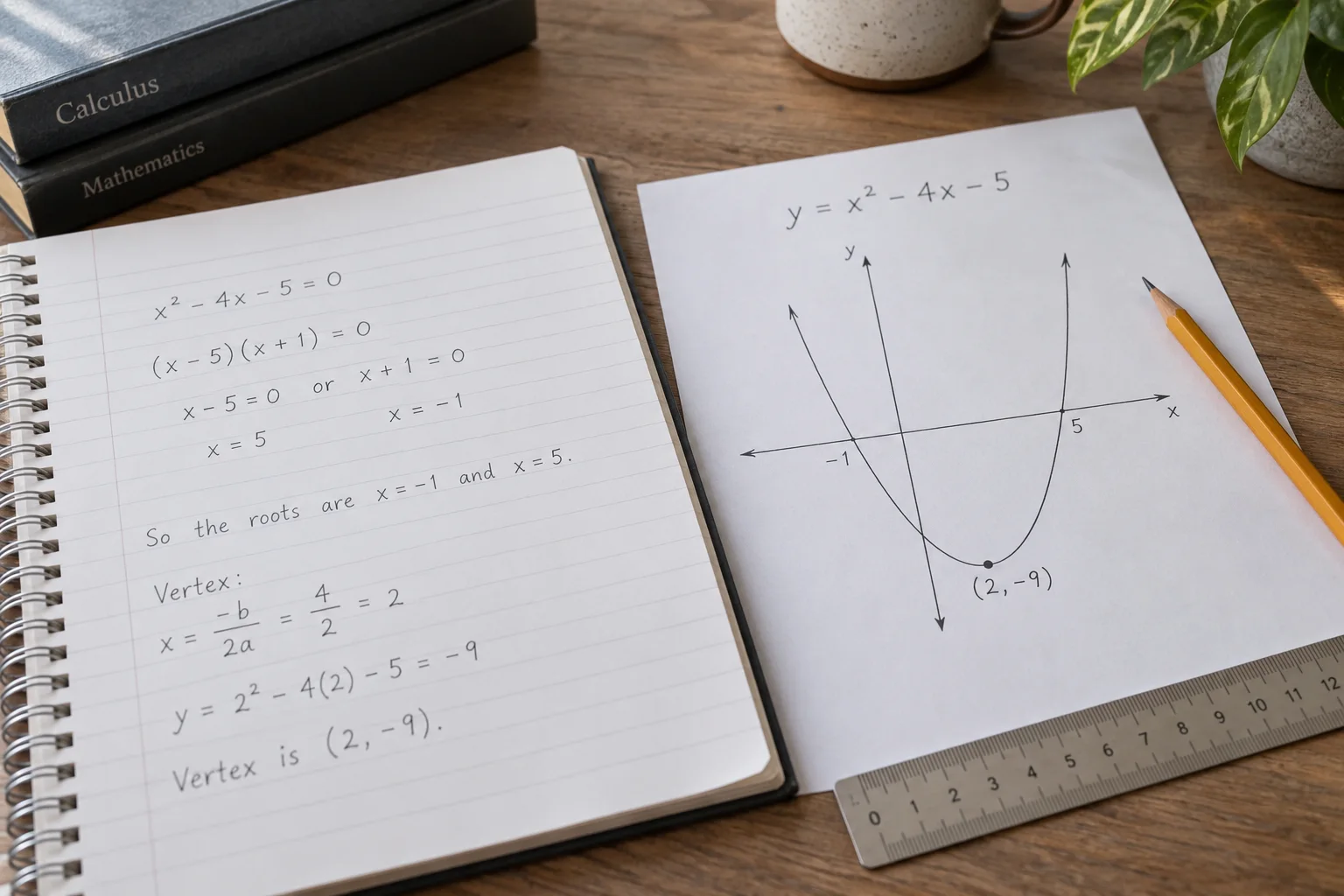
We identify what the student is studying, which skills need strengthening and what their next assessment will cover. Lessons can focus on the current school topic while revisiting earlier knowledge when it is needed for a new concept.
This keeps practice relevant. It also helps students recognise connections between topics instead of treating every question as an isolated procedure.
Our approach
Understand the concept and method
Original learning example
A quadratic in context
Concept
- y = x² − 4x + 3
- Factor: (x − 1)(x − 3)
Show approach
Application
- Roots: x = 1 and x = 3
- Axis of symmetry: x = 2
- Vertex: (2, −1)
We explain why a method works and when it is useful. Teachers model the reasoning, work through examples and check that students can explain what they are doing.
Students then practise the core skill until they can use it reliably. When they make an error, we identify whether it comes from the concept, the choice of method or the execution of a step.
Practise regularly and target weak points
Original learning example
Quadratics: three levels
Build
- Solve x² − 9 = 0
Show approach
Apply
- Solve x² − 4x + 3 = 0
- Challenge: find the vertex of y = x² − 4x + 3
Regular homework gives students opportunities to consolidate new skills between lessons. We review their working, address misconceptions and provide tiered extra practice for areas that need attention.
Questions progress from establishing fluency to choosing and combining methods independently. Students learn to check their answers using the information and constraints in the question.
Prepare for school assessments
Original learning example
Review a method
Original sample working
- x² − 4x + 3 = 0
- (x − 1)(x − 3) = 0
- x = 1 or x = 3
Show approach
Feedback
- Strong: correct factorisation
- Improve: state the zero-product rule
- Check both values in the equation
Before an upcoming assessment, we provide practice and mock tests tailored to the student’s school topics. Reviewing a mock test helps reveal which skills are secure and which need focused revision.
We look beyond the final mark: an incorrect answer might come from a small algebraic slip, a misunderstood concept or a method that takes too long. The next practice set addresses the actual cause.
Experience challenging trial and HSC style questions
Original learning example
Plan an exam-style solution
Original multi-part question
- f(x) = x² − 4x + 3
- (a) Find the zeros
- (b) Find the minimum value
Show approach
First step
- Factor to locate the zeros
- Then use symmetry or completing square
- Explain what each answer means
We create questions that simulate the demands of challenging past trial and HSC papers. Students encounter unfamiliar wording, multi-step reasoning and problems that require them to decide which ideas to connect.
They practise planning an approach, presenting clear working and checking whether their solution answers every part of the question. We discuss alternative methods so students can recognise a more efficient route when one is available.
This practice helps students develop a realistic feel for demanding exam questions without relying on memorised solutions to particular past papers.
What students work towards
Students work towards applying Mathematics Advanced concepts accurately and flexibly. They learn to recognise what a question requires, select an effective method and communicate a complete solution under assessment conditions.
References
-
NESA — Mathematics Advanced 11–12 Syllabus (2024):
https://curriculum.nsw.edu.au/learning-areas/mathematics/mathematics-advanced-11-12-2024/overview -
NESA — Mathematics Advanced Stage 6 Syllabus (2017):
https://www.nsw.gov.au/education-and-training/nesa/curriculum/mathematics/mathematics-advanced-stage-6-2017