



Understand the principles, model the problem and explain the result
Physics asks students to connect ideas, mathematical relationships and evidence. Knowing an equation is useful, but students also need to understand when it applies, what each quantity represents and whether the answer makes physical sense.
Our HSC Physics lessons follow the NESA syllabus applicable to each student’s year group and connect with the topics they are studying at school. We build a clear understanding of the principles, then practise using them to solve problems and explain physical phenomena.
Aligned with school learning and the NESA syllabus
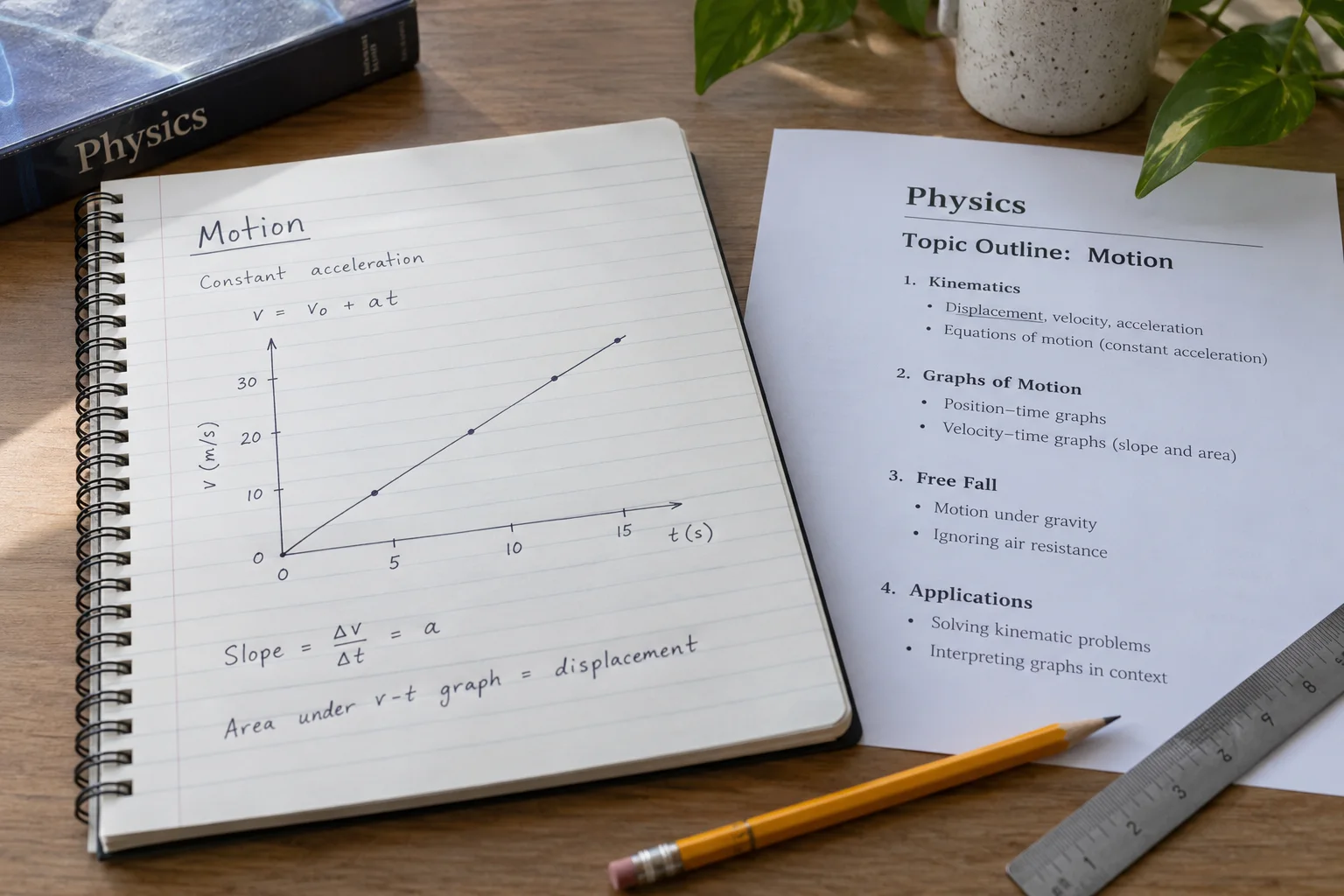
We identify the student’s current school topic, syllabus requirements and upcoming assessments. Lessons focus on the concepts and skills relevant to that work, even when different schools teach topics in different orders.
Students receive support for what they need now while developing methods they can use across Physics: representing a situation, choosing a model, working through the mathematics and interpreting the result.
Our approach
Understand the physical principle
Original learning example
From motion to forces
Physical situation
- A 2 kg book rests on a table
- It is stationary
Show approach
Force model
- Weight: 19.6 N downward
- Normal force: 19.6 N upward
- Net force: 0 N
We begin by asking what is happening in a physical system and why. Diagrams, demonstrations, graphs and thought experiments help students connect an abstract idea to something they can visualise.
Students learn what a model assumes and where it can be used. This helps them explain a result, rather than treating Physics as a collection of equations to memorise.
Represent and solve the problem
Students practise translating a question into useful working: a labelled diagram, a graph, a list of known quantities or a mathematical relationship.
They learn to choose an appropriate method, follow the steps carefully and check units, direction and the reasonableness of an answer. We also compare different approaches when a problem can be solved in more than one way.
Use evidence to explain
Original learning example
Reading a motion graph
Velocity against time
- 0 s → 0 m/s
- 2 s → 4 m/s
- 4 s → 8 m/s
- 6 s → 8 m/s
Show approach
Interpret it
- 0–4 s gradient: 2 m/s²
- 4–6 s: constant velocity
- Area under curve = displacement
Physics assessments can ask students to interpret data, evaluate an investigation or explain how evidence supports a conclusion. We practise reading graphs and experimental results, identifying patterns and limitations, and writing clear scientific explanations.
Regular homework reinforces the concepts and methods taught in lessons. We review students’ work to identify misconceptions and provide extra practice focused on areas that need attention.
Prepare for school assessments and the HSC
Original learning example
Newton's second law
Original question
- A 2 kg object has net force 6 N
- Find its acceleration
Show approach
Working and check
- F = ma → a = F ÷ m
- = 6 N ÷ 2 kg = 3 m/s²
- Units match acceleration
We provide practice and mock tests tailored to the student’s upcoming school assessments and the applicable NESA syllabus. Students work through a range of questions, then review both their answers and their methods.
Feedback addresses the Physics and the communication of it: whether a student selected a suitable model, used quantities correctly, showed clear reasoning and answered the question asked.
Extend students who are ready
Original learning example
Two-stage motion
Original extension problem
- Start from rest; accelerate at 2 m/s² for 4 s
- Then continue at constant speed for 3 s
Show approach
Plan a solution
- First find v after 4 s
- Find distance in each stage
- Add the two distances
Students seeking a greater challenge can explore selected problems sourced from Physics competitions in Australia and around the world, including Australian Science Olympiad and international Olympiad-style material.
These problems often require students to combine ideas, make careful assumptions and work through an unfamiliar situation. We select challenges suited to the student’s knowledge and teach additional concepts where needed.
Competition problems are an optional extension. The core course remains aligned with the student’s NESA syllabus and school assessments.
What students work towards
Students work towards explaining physical phenomena, solving unfamiliar problems methodically and interpreting evidence with confidence. They learn to use equations as tools for reasoning and to communicate how they reached a result.
Through syllabus-aligned lessons, regular practice and targeted feedback, students prepare for school assessments and develop a deeper understanding of Physics.
References
-
NESA — Physics Stage 6 Syllabus (2017):
https://www.nsw.gov.au/education-and-training/nesa/curriculum/science/physics-stage-6-2017 -
NESA — Physics 11–12 Syllabus (2025):
https://curriculum.nsw.edu.au/learning-areas/science/physics-11-12-2025/overview -
Australian Science Innovations — Physics Olympiad past exams:
https://asi.edu.au/program/australian-science-olympiads/past-exams-with-answers/physics-olympiad-past-exams/