



Build a method, apply it under time pressure, and explore deeper problems
Mathematical Reasoning asks students to use familiar mathematical ideas in unfamiliar situations. A question might require them to interpret a diagram, uncover a pattern, compare possible methods or combine several pieces of information.
Our course teaches students to understand the problem before calculating, choose an efficient approach and check whether their answer makes sense. OCPT and SHSPT students follow the same four-stage progression, with question difficulty matched to their test and current ability.
The Mathematical Reasoning tests
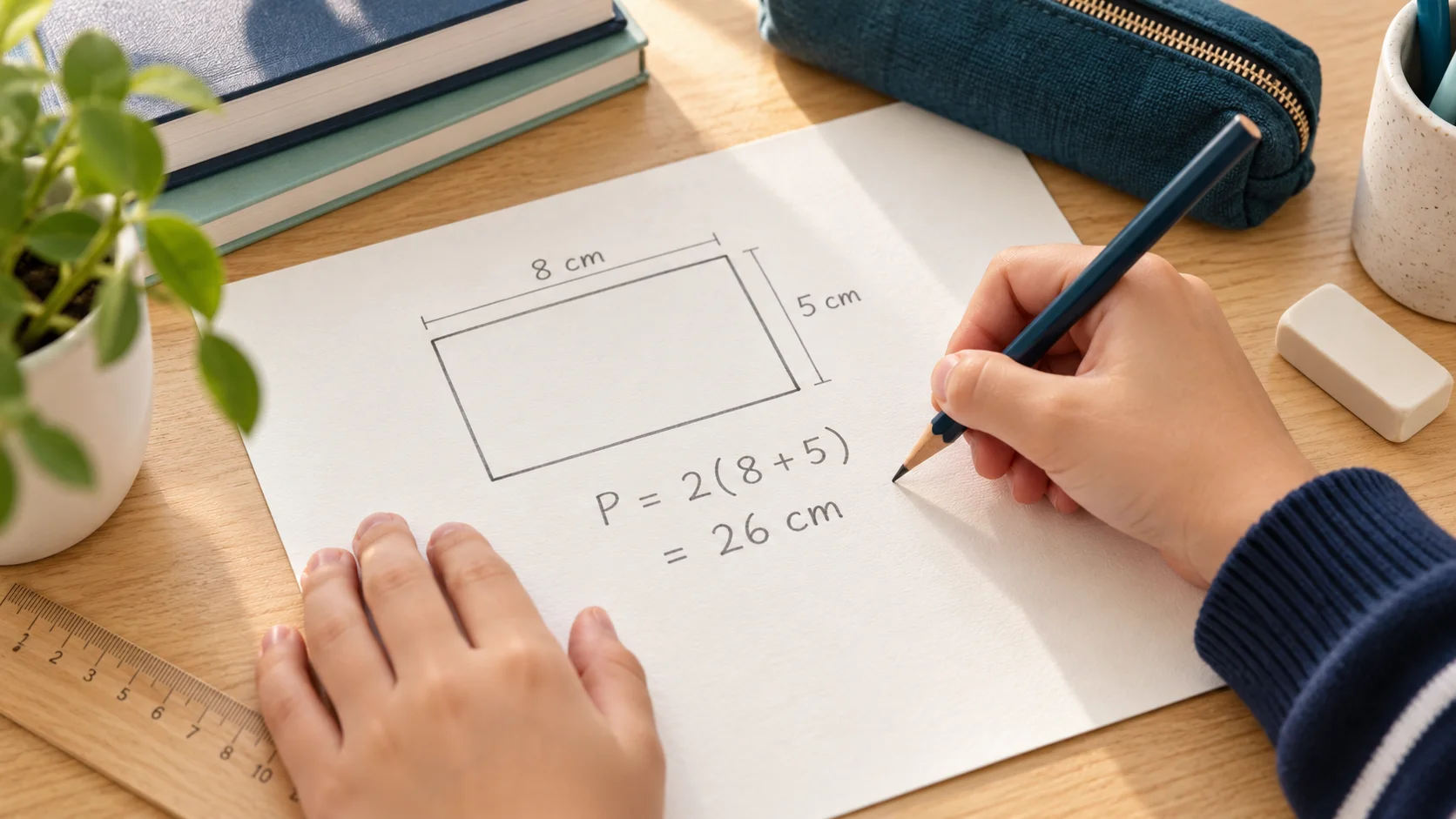
Original learning example
Two original practice examples
OCPT-style reasoning
- A pattern adds 3 each time
- 4, 7, 10, __ ?
Show approach
SHSPT-style reasoning
- A rectangle is 8 cm by 5 cm
- What is its perimeter?
- Show how you know
The OCPT and SHSPT Mathematical Reasoning tests each contain 35 multiple-choice questions in 40 minutes, with five answer options per question. Students cannot use a calculator, but they may use paper for working.
The questions assess how students apply mathematical understanding to new problems. Our practice draws on areas such as number, measurement, geometry, patterns and data, while emphasising the reasoning needed to solve a question rather than memorising a procedure.
Our approach
We teach students to identify what is known, what must be found and which mathematical ideas connect the two. They practise representing information with a diagram, table, number line or organised list when it helps.
Students also learn to estimate, compare answer options and check their results. The goal is to develop flexible problem solving: if one method is slow or unproductive, they can recognise that and try another.
Stage 1: Learn the common question types
Students work through common Mathematical Reasoning question types in focused lessons. For each type, the teacher models how to interpret the wording, select relevant information and build a solution.
Students practise methods such as drawing a diagram, making a table, working backwards, finding a pattern and testing possible answers. They explain why their chosen answer works and learn to recognise common errors, such as overlooking a condition or using the wrong unit.
Stage 2: Apply the methods in mock tests
Students move from topic-based practice to mixed mock tests, followed by timed mock tests matched to OCPT or SHSPT conditions.
They practise pacing, deciding how much time to spend on a question and returning to difficult questions when appropriate. After each test, students review incorrect and unfinished questions. This helps them distinguish between a gap in mathematical understanding, a misread question, an inefficient method and a calculation error.
Stage 3: Tackle harder, multi-step problems
Original learning example
One problem, two methods
Original question
- Three packs hold 18 pencils
- How many in five equal packs?
Show approach
Table method
- 1 pack → 6 pencils
- 5 packs → 30 pencils
- Diagram: five groups of six → 30
Students work on questions that require several connected steps or an insight that is not immediately obvious. They learn to break a complex problem into smaller parts and decide which information matters at each stage.
Problems may involve patterns, counting possibilities, spatial reasoning, number properties or constraints that must all be satisfied. Students compare different solutions and look for methods that are both correct and efficient.
Stage 4: Explore competition-style challenges
Original learning example
A growing tile pattern
Original challenge
- Figure 1: 3 tiles
- Figure 2: 5 tiles
- Figure 3: 7 tiles
Show approach
Investigate
- What changes each time?
- Draw Figure 4
- Predict Figure 10 and explain
Students explore age-appropriate problems drawn from or inspired by mathematics competitions, including the Australian Mathematics Competition (AMC), MOEMS and APSMO.
These challenges encourage creative approaches, careful justification and persistence with unfamiliar problems. Where needed, teachers adapt the context or difficulty and create modified questions that develop the same reasoning skill.
This is an extension of our course. Competition problems are used to deepen mathematical thinking; they are not presented as official OCPT or SHSPT question types.
What students work towards
Students work towards reading unfamiliar problems carefully, selecting an effective method and answering accurately within the available time. They learn to show enough working to keep their reasoning organised, even when the final answer is multiple-choice.
For students ready to go further, competition-style problems provide opportunities to explore elegant solutions and develop a lasting interest in mathematical problem solving.
References
-
NSW Department of Education — Opportunity Class Placement Test:
https://education.nsw.gov.au/schooling/students/oc-and-shs/going-to-an-opportunity-class/get-ready-for-the-opportunity-class-placement-test -
NSW Department of Education — Selective High School Placement Test:
https://education.nsw.gov.au/schooling/students/oc-and-shs/going-to-a-selective-high-school/get-ready-for-the-selective-high-school-placement-test -
Australian Maths Trust — Australian Mathematics Competition:
https://amt.edu.au/amc -
MOEMS — Math Olympiads for Elementary and Middle Schools:
https://www.moems.org/ -
APSMO:
https://apsmo.edu.au/