


Build stronger readers and more confident writers
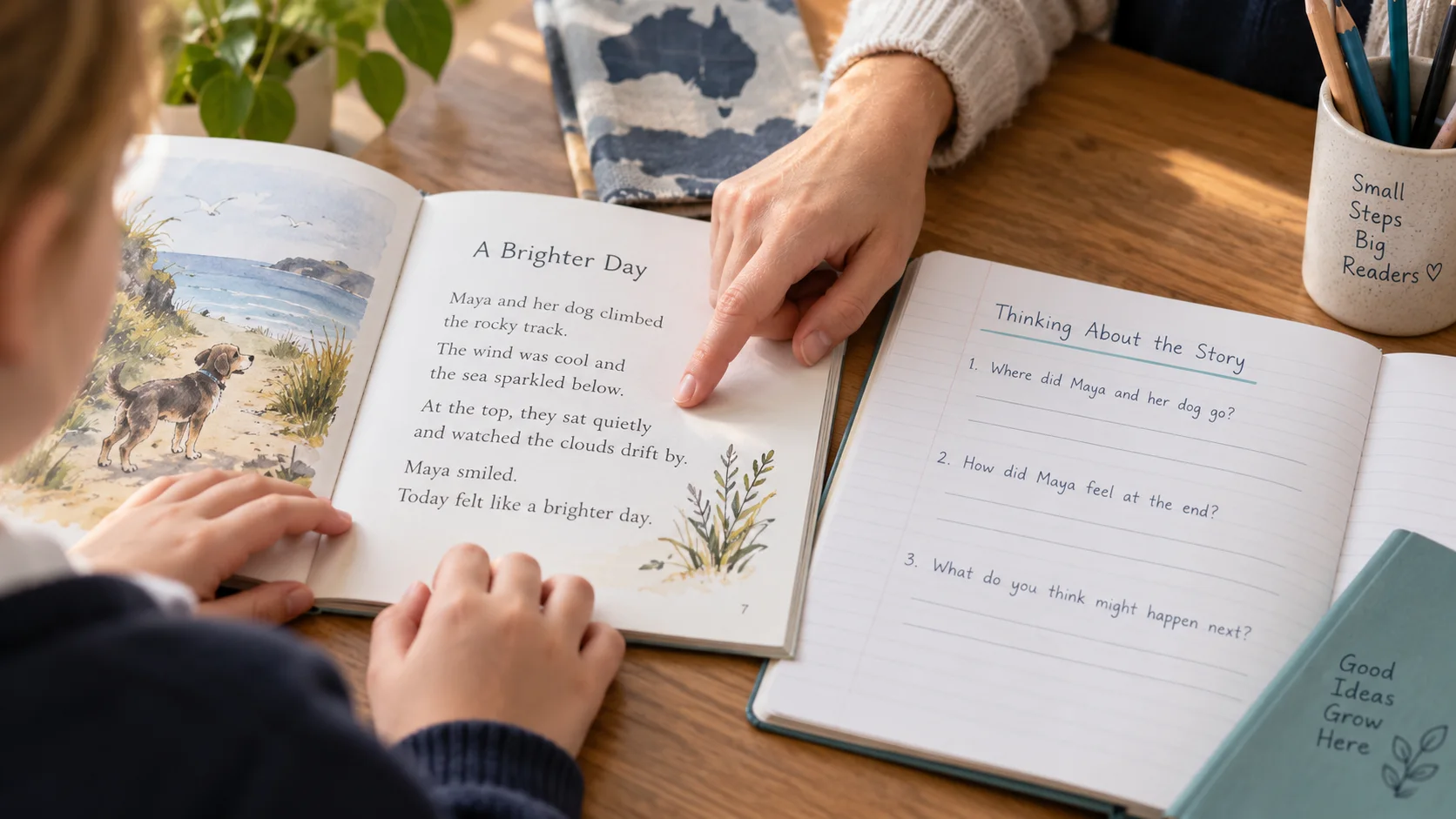
Strong English skills help students understand what they read and express what they think. Our Primary English course develops both sides together: students learn how to approach different reading questions and how to turn their own ideas into clear writing.
Lessons include explicit teaching, guided practice and opportunities for students to apply each skill independently.
Reading: learn how to approach the question
Original learning example
Four ways to read closely
Original passage
- Mia tucked the map into her bag.
- Clouds gathered over the oval.
- She hurried towards the library.
Show approach
Question types
- Fact: What did Mia put away?
- Synthesis: What is changing?
- Inference: Why might she hurry?
- Language: What mood do the clouds create?
Students can understand a passage yet still struggle to answer questions about it. We teach common comprehension question types systematically, so students learn what each question asks them to do and how to find a well-supported answer.
Fact-finding questions
Students locate information stated directly in the text. They practise identifying the key words in a question, finding the relevant passage and answering precisely.
Synthesis questions
Students bring together information from different sentences or parts of a text. They learn to connect details and form a complete answer rather than copying one line that only addresses part of the question.
Inference questions
Students use clues in the text to work out something the author suggests without stating it directly. They practise explaining which details support their inference.
Language-feature questions
Students identify a writer’s language choices and explain their effects. The focus is on how a choice shapes meaning or influences the reader, not simply naming a technique.
Across all four types, students practise returning to the text to check that their answer is supported by evidence.
Writing: from sentence skills to complete pieces
Original learning example
From idea to paragraph
Idea and plan
- Idea: a surprising discovery
- Place: the school garden
- Detail: a tiny blue key
Show approach
Original paragraph
- I spotted a blue key beneath the leaves.
- Its paint was chipped, but it still shone.
- I wondered what it might open.
Original learning example
A clearer sentence
First draft
- the dog ran to the gate it barked
Show approach
Revision
- The dog ran to the gate and barked.
- Capital letter starts the sentence.
- Full stop closes it.
We teach the foundations that make writing clear, including sentence construction, grammar and punctuation. Students practise applying these skills in their own sentences and paragraphs, rather than only correcting isolated examples.
They also explore different writing styles and forms. Lessons help students recognise the purpose and audience of a task, generate ideas, organise them and make suitable language choices. As their skills develop, they plan, draft and revise more independent pieces of writing.
NAPLAN practice
Original learning example
Use clues from the text
Original passage
- The path was wet and the leaves shone.
- Mia folded her umbrella.
Show approach
Question and clue
- What had happened recently?
- Clue: wet path + umbrella
- Likely answer: it had rained
Students also receive NAPLAN practice as part of their reading and writing development. Practice helps them become familiar with assessment-style questions and apply the skills they have learned to unfamiliar texts and prompts.
We review their responses to identify which reading strategies or writing skills need more attention. NAPLAN practice supports the course; the broader goal is to build skills students can use in everyday schoolwork.
What students work towards
Students work towards reading carefully, recognising what a question requires and supporting their answers with evidence. In writing, they develop the sentence skills, organisation and confidence to communicate their ideas for different purposes.
By teaching these skills step by step and revisiting them in new contexts, we help students become more independent readers and writers.