



Understand the idea, practise the skill and build confidence
A strong foundation in mathematics comes from understanding what numbers and methods mean, then practising until students can use them confidently. Our Primary Mathematics lessons help students build that foundation one step at a time.
We pay attention to how each student thinks through a problem. Their working helps us see what they understand, where they become unsure and what to teach next.
Our approach
Make sure students understand
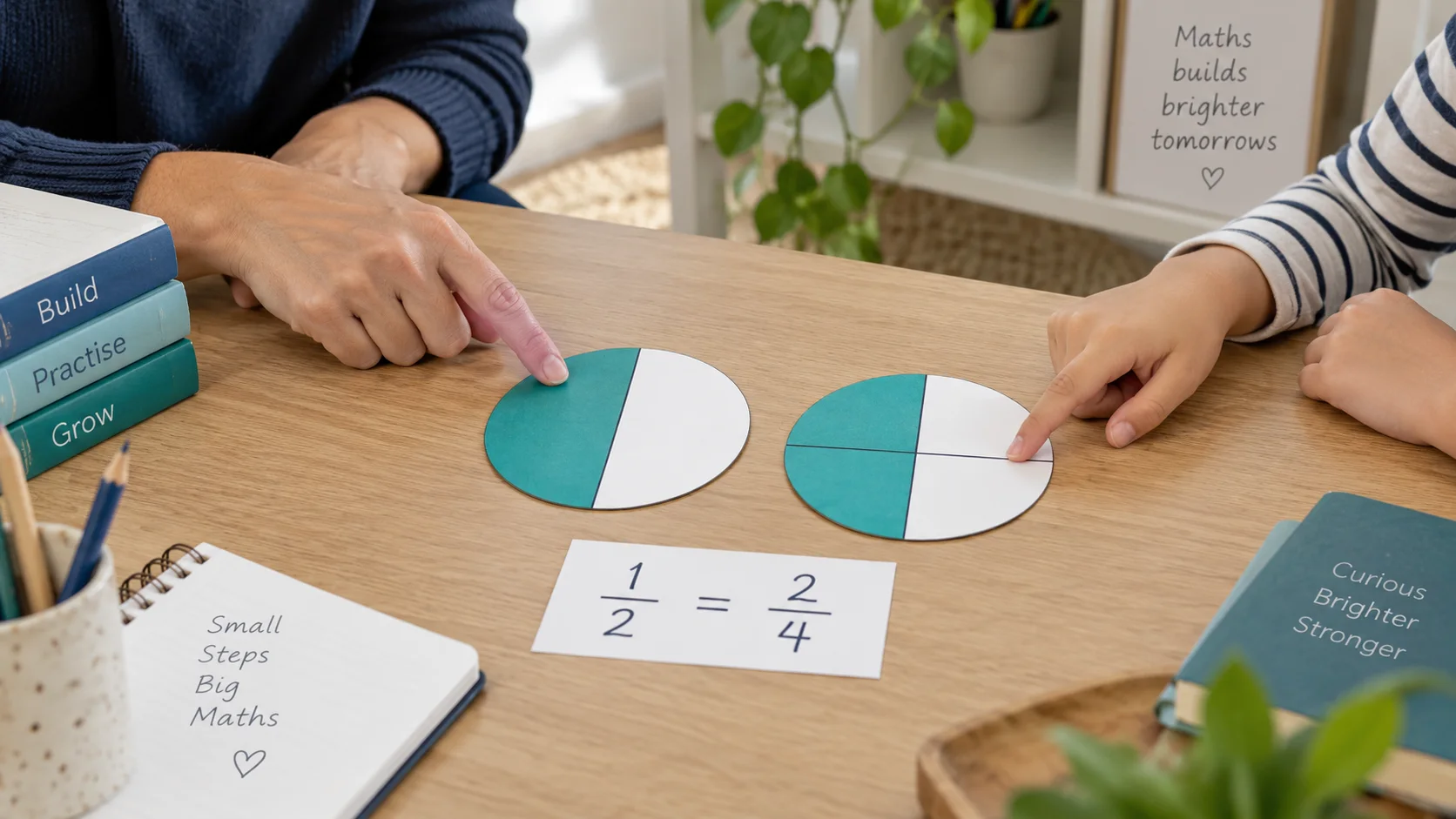
Teachers introduce ideas with clear explanations, examples and visual representations where useful. Students are encouraged to explain their thinking, ask questions and try more than one way to approach a problem.
Before moving on, we check whether students can apply the idea independently. This helps prevent a small misunderstanding from becoming a larger difficulty in later topics.
Build skills through regular homework
Original learning example
Fractions: practice that builds
Guided
- Find one half of 12: split into 2 groups.
Show approach
Independent
- Find one quarter of 20.
- Apply: 20 apples, one quarter green.
- How many are green?
Students receive regular homework to practise what they have learned in lessons. This gives them time to strengthen a new skill and helps teachers see whether they can use it without immediate guidance.
We review their work and use it to plan the next lesson. An incorrect answer is an opportunity to find out whether the student misunderstood the concept, chose an unsuitable method or made a calculation error.
Target individual weak points
Original learning example
Equivalent fractions
Start
- 1/2 = __/4
- 1/3 = __/6
Show approach
Extend
- 2/3 = __/12
- Explain why 3/6 = 1/2
- Use a fraction strip to check
When a student needs more support with a particular skill, we provide extra practice focused on that area. Questions begin at an appropriate level and build towards more independent or challenging applications.
This targeted practice helps students address the specific difficulty holding them back, rather than simply completing more questions from every topic.
Keep parents informed

We actively discuss students’ learning with parents. We share the skills being developed, areas that need more attention and how students are progressing.
These conversations help parents understand the purpose of the homework and extra practice, while allowing us to hear about any difficulties the student experiences outside lessons.
What students work towards
Students work towards understanding mathematical ideas, choosing suitable methods and explaining how they reached an answer. With regular practice and support focused on their needs, they build accuracy and confidence for their school mathematics.