



Understand biological systems, apply evidence and prepare for the HSC
Biology asks students to do more than remember definitions. They need to explain processes, connect ideas across a biological system, interpret evidence and apply what they know to unfamiliar questions.
Our HSC Biology lessons follow the NESA syllabus applicable to each student’s year group and connect with the topics they are studying at school. We build understanding first, then give students regular opportunities to practise using that understanding in questions and assessments.
Aligned with school learning and the NESA syllabus
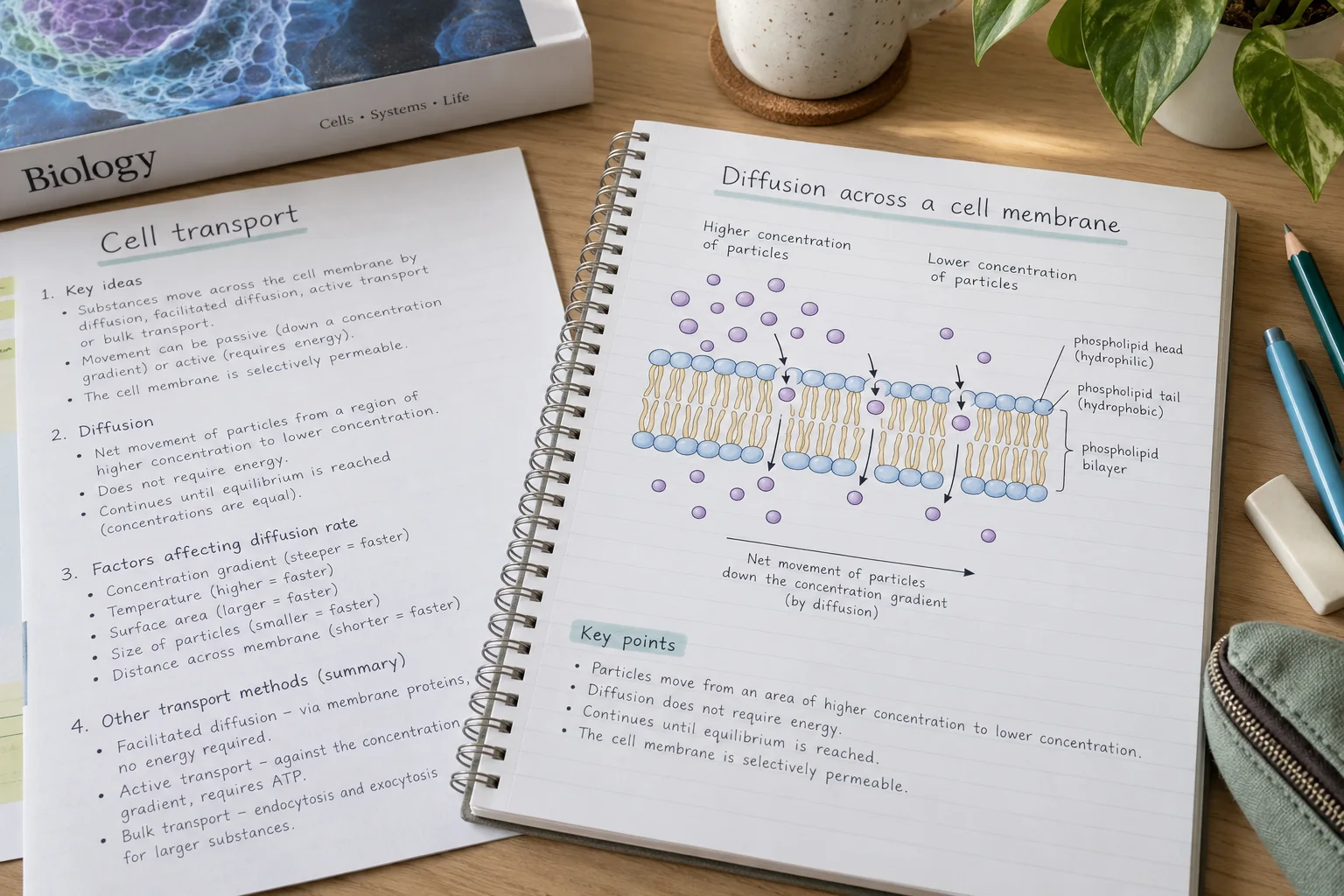
We identify the student’s current school topic, syllabus requirements and upcoming assessment. Lessons focus on the knowledge and scientific skills relevant to that work, while helping students see how individual concepts fit together.
This is especially useful when schools teach topics in different orders. Students receive support for what they are learning now, rather than being placed in a lesson on an unrelated area of Biology.
Our approach
Understand the biological process
Original learning example
Diffusion across a membrane
Starting pattern
- More particles outside
- Fewer particles inside
Show approach
What happens
- Net movement: high to low
- Particles move both ways
- Equilibrium: no net change
We begin with the underlying idea: what happens, why it happens and how the parts of a system interact. Diagrams, models and carefully chosen examples help students make sense of complex processes.
Students practise explaining concepts in their own words and using accurate biological terms. This helps them move beyond memorised sentences towards an understanding they can apply when a question is phrased differently.
Interpret evidence and apply knowledge
Original learning example
Interpreting enzyme data
Activity against temperature
- 10°C → 2 units
- 20°C → 5 units
- 30°C → 9 units
- 40°C → 6 units
Show approach
Read the evidence
- Activity rises to 30°C
- It then falls by 3 units
- Do not claim a cause from this graph alone
Biology questions often ask students to work with unfamiliar information. We practise interpreting graphs, experimental results, diagrams and biological scenarios, then connecting that evidence to relevant concepts.
Students learn to identify what a question asks, select the information that matters and build an answer supported by biological reasoning.
Practise consistently
Regular homework gives students practice with the concepts and question types covered in lessons. We review their answers to find misconceptions, gaps in knowledge and difficulties with written explanations.
Where needed, we provide additional questions focused on a student’s weaker areas. Practice can progress from checking core understanding to applying several ideas in a new situation.
Prepare for school assessments and the HSC
Original learning example
Evidence in an explanation
Original practice response
- Claim: activity is highest at 30°C
- Evidence: 9 units at 30°C
- Compare: 6 units at 40°C
Show approach
Teacher note
- The claim matches the data
- Add why temperature may affect an enzyme
- Distinguish data from explanation
We provide practice and mock tests tailored to the student’s upcoming school assessments and the applicable NESA syllabus. Students practise responding to questions under time constraints, then review their answers to see where their explanations need greater accuracy, depth or clarity.
Feedback focuses on both the Biology and the communication of it: whether the student has answered the question, used evidence appropriately and explained the reasoning connecting their ideas.
Extend students who are ready
Original learning example
An unfamiliar habitat
Original extension problem
- Pond A: 8 insect species
- Pond B: 5 insect species
- Both have the same sampling effort
Show approach
Reasoning steps
- Compare diversity first
- Consider other habitat variables
- What more evidence is needed?
Students who want a greater challenge can explore selected problems sourced from biology competitions around the world, including Australian and international Olympiad-style material.
These problems may require students to interpret unfamiliar data, connect ideas from different areas of Biology or reason through a complex investigation. We select questions suited to the student’s current knowledge and teach any additional background needed.
Competition challenges are an optional extension. The core course remains aligned with the student’s NESA syllabus and school assessments.
What students work towards
Students work towards explaining biological processes accurately, interpreting evidence with confidence and applying their understanding to unfamiliar questions.
By combining syllabus-aligned lessons, regular practice and targeted feedback, we help students prepare for their immediate assessments and develop stronger scientific reasoning.
References
-
NESA — Biology Stage 6 Syllabus (2017):
https://www.nsw.gov.au/education-and-training/nesa/curriculum/science/biology-stage-6-2017 -
NESA — Biology 11–12 Syllabus (2025):
https://curriculum.nsw.edu.au/learning-areas/science/biology-11-12-2025/overview -
Australian Science Innovations — Australian Science Olympiads:
https://asi.edu.au/program/australian-science-olympiads/ -
International Biology Olympiad:
https://www.ibo-info.org/