



Understand the reactions, master the calculations and explain the evidence
Chemistry connects what we observe in a reaction to what happens between particles. Students need to understand those connections, use chemical language accurately and apply mathematical methods to unfamiliar problems.
Our HSC Chemistry lessons follow the NESA syllabus applicable to each student’s year group and focus on the topics they are studying at school. We explain the underlying ideas, practise the calculations and help students communicate their reasoning clearly.
Aligned with school learning and the NESA syllabus
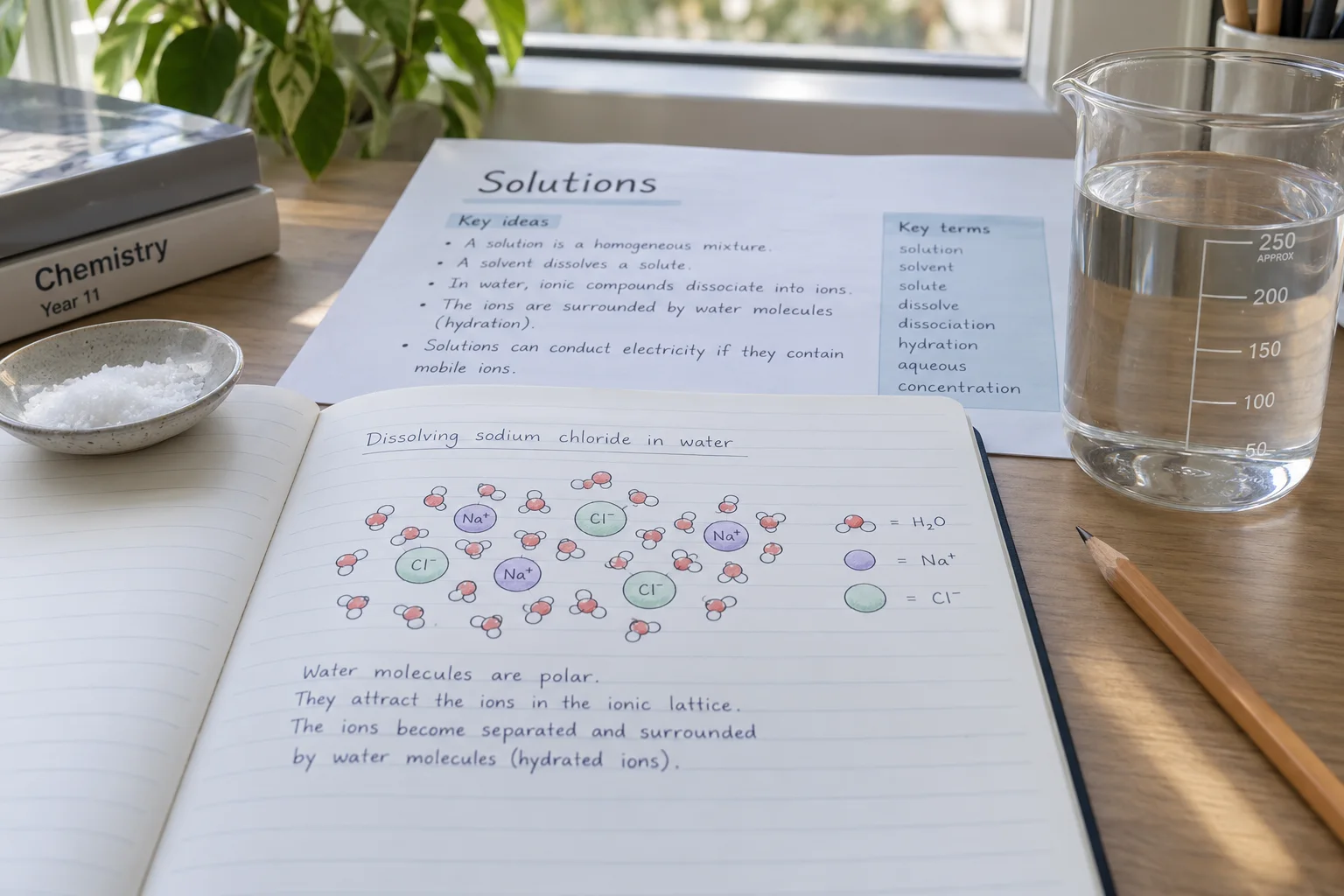
We identify the student’s current topic, the work their school has covered and their upcoming assessments. Lessons can then focus on the chemical concepts, practical skills and calculations most relevant to that student.
Schools may teach topics in different orders. Our teaching follows the student’s needs rather than placing them in a lesson on an unrelated unit.
Our approach
Understand what happens at the particle level
Original learning example
Dissolving salt in water
Observation
- The visible salt crystals disappear
- The solution stays clear
Show approach
Particle model
- NaCl(s) → Na⁺(aq) + Cl⁻(aq)
- Ions disperse through water
- Matter is conserved
We begin with the chemical idea behind a process. Students use particle models, structures and reaction diagrams to connect what can be observed with what is happening between atoms, ions or molecules.
They learn to explain why a reaction occurs or why a substance has particular properties, rather than relying only on a memorised definition or equation.
Build confidence with calculations
Original learning example
A mole calculation
Original question
- What is n for 5.85 g of NaCl?
- M(NaCl) = 58.5 g mol⁻¹
Show approach
Working and check
- n = m ÷ M
- = 5.85 ÷ 58.5
- = 0.100 mol (units checked)
Students practise translating a question into chemical quantities and relationships. We work through the method, the units and the meaning of the result before moving to questions that require students to choose an approach independently.
Regular practice helps students recognise when a calculation is needed, set it up accurately and check whether the answer is reasonable.
Interpret experimental evidence
Original learning example
A reaction-rate investigation
Gas volume against time
- 0 s → 0 mL
- 20 s → 12 mL
- 40 s → 20 mL
- 60 s → 24 mL
Show approach
Interpret the trend
- Volume rises throughout
- Increase per 20 s gets smaller
- Rate slows as reactants are used
Chemistry questions can involve observations, graphs, data tables and practical methods. Students practise identifying trends, explaining results and connecting evidence to chemical principles.
We also help students write precise responses: selecting relevant information, using correct terminology and explaining the reasoning between an observation and a conclusion.
Practise and prepare for assessments
Regular homework reinforces the ideas and methods covered in lessons. We review students’ work to identify misconceptions, calculation errors and areas that need further practice.
Before an upcoming school assessment, we provide practice and mock tests tailored to the topics the student is studying and the applicable NESA syllabus. Feedback helps students focus their revision on the concepts and question types that need the most attention.
Extend students who are ready
Original learning example
Limiting reactant
Original extension problem
- 2H₂ + O₂ → 2H₂O
- Start: 4 mol H₂ and 3 mol O₂
Show approach
Plan a solution
- Use the 2:1 mole ratio
- Which reactant runs out first?
- What amount remains?
Students seeking a greater challenge can explore selected problems sourced from Chemistry competitions in Australia and around the world, including Australian Science Olympiad and international Olympiad-style material.
These problems may combine several chemical ideas or present an unfamiliar experimental situation. We select challenges appropriate to the student’s knowledge and teach additional background where needed.
Competition questions are an optional extension. The core course remains focused on the student’s school learning and NESA syllabus.
What students work towards
Students work towards explaining chemical processes accurately, solving quantitative problems methodically and using evidence to support their conclusions.
Through syllabus-aligned lessons, regular practice and targeted feedback, they prepare for school assessments while developing a deeper understanding of Chemistry.
References
-
NESA — Chemistry Stage 6 Syllabus (2017):
https://www.nsw.gov.au/education-and-training/nesa/curriculum/science/chemistry-stage-6-2017 -
NESA — Chemistry 11–12 Syllabus (2025):
https://curriculum.nsw.edu.au/learning-areas/science/chemistry-11-12-2025/overview -
Australian Science Innovations — Chemistry Olympiad past exams:
https://asi.edu.au/program/australian-science-olympiads/past-exams-with-answers/chemistry-olympiad-past-exams/