



From a blank page to a confident response
Our SHSPT Writing course helps students move from guided writing practice to independently planning and completing a response to an unfamiliar prompt.
The writing test
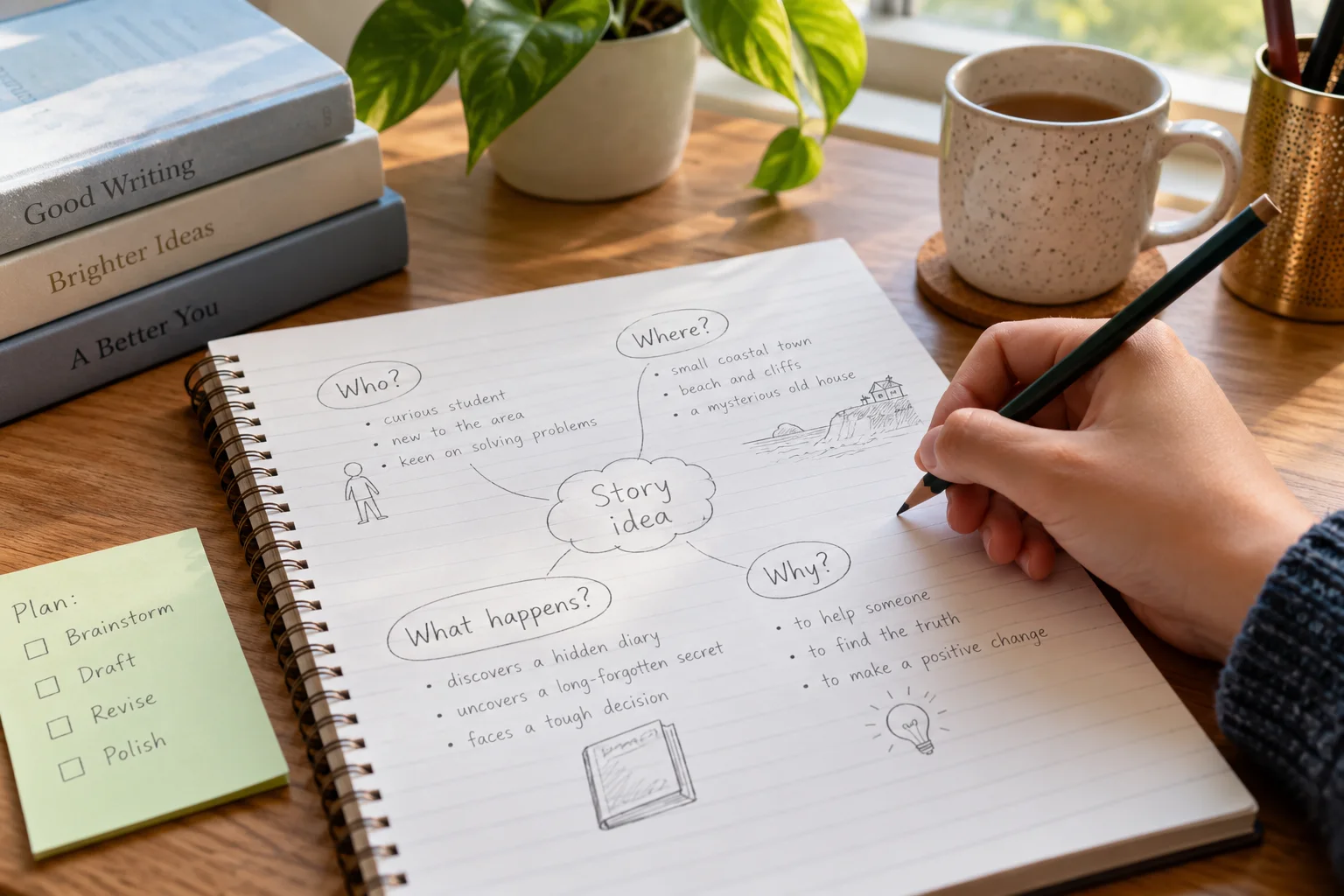
Original learning example
Original writing practice prompt
Task
- Write a story about a surprising discovery.
- You may use the title “The Hidden Key”.
Show approach
Plan before writing
- Who makes the discovery?
- Where does it happen?
- What changes by the end?
The NSW Selective High School Placement Test includes one writing task completed in 30 minutes. Students read the prompt, plan their ideas and type a response that follows the instructions.
The task assesses the creativity of students’ ideas and how effectively they write for a purpose and audience. Structure, style, vocabulary, grammar, spelling and punctuation also contribute to the result. A response must address the given topic, even if the writing itself is fluent.
The exact prompt changes. Students may practise imaginative, persuasive and other purposeful writing, but our focus is on understanding the instructions in front of them rather than memorising a response.
Our approach
Good writing begins with good decisions. Students learn to identify what a question requires, generate relevant ideas, organise them into a plan, choose language that serves their purpose, and review whether the finished response stays focused.
We use model responses to make those decisions visible. Students complete missing sections of sample writing, work backwards to reconstruct a model’s plan, and discuss why particular language choices are effective. As their skills grow, the amount of support gradually decreases.
Stage 1: Understand how a response is built
Students analyse the question, study sample responses, complete cloze passages and identify useful language features. They reverse engineer a model response to see how it was planned, then write their own response from a provided plan.
Stage 2: Choose language with purpose
Students still write from a provided plan, but now select the language features they intend to use before they begin. They practise choosing techniques that suit the task, such as dialogue or sensory detail in a narrative, or a clear line of reasoning in persuasive writing.
The aim is to make language choices deliberate and effective.
Stage 3: Plan and write independently
The provided plan is removed. Students analyse an unfamiliar prompt, develop their own plan, select suitable language features and write a complete response.
This stage develops the independence needed for the writing test.
Stage 4: Evaluate and refine
Students evaluate sample responses by asking whether they address the question and whether their language choices suit the task. They then apply that judgement to their own independently planned writing.
What students work towards
Original learning example
Revise a short narrative
Original response
- “I found a key in the garden.
- It glinted under the leaves.
- I heard footsteps behind me.”
Show approach
Annotations
- Idea: a discovery starts the story.
- “Glinted” gives a sharp visual detail.
- Revision: clarify who is approaching.
Students work towards approaching an unfamiliar prompt calmly, forming a practical plan and producing a focused response within the test time. Feedback addresses the decisions behind the writing: relevance, ideas, organisation and expression.
Students enter at a stage suited to their current writing ability. Each stage typically takes 10–20 lessons, with the pace adjusted to their progress.
Reference
NSW Department of Education:
https://education.nsw.gov.au/schooling/students/oc-and-shs/going-to-a-selective-high-school/get-ready-for-the-selective-high-school-placement-test